 |
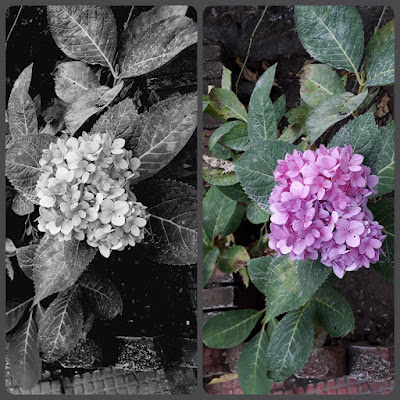
In a world of grayscale sighs, where silence softly weeps, A bloom stood still in quiet grace, where color gently sleeps. Its petals pale in whispered tones, a dream not yet unfurled, As if it waited for the sun to bring it back to world.
Then came a breath, a morning light, and color kissed the leaves, From ghostly grey to violet bright — a miracle that breathes. The same flower, yet so alive, once bathed in moon’s despair, Now dances bold with hues of joy, in fragrant summer air.
This side-by-side is not just art, it speaks of hope and time, That even through the darkest days, your colors will still climb. For every bloom that's lost in black, a purple waits to shine, A gentle nudge from nature’s brush: “Your season will be fine.” |
Monday, June 9, 2025
From Shadows to Bloom

Monday, May 12, 2025
Karma Theory
Karma Theory: What You Give, That You Get
Introduction
The ancient law of karma, deeply rooted in Hinduism,
Buddhism, Jainism, and Sikhism, is a fundamental spiritual concept that
transcends religion and philosophy. It operates on a simple yet profound
premise: what you give is what you get. Karma, a Sanskrit word meaning
“action” or “deed,” implies that every thought, word, or act has consequences.
This cosmic principle is not about punishment or reward in the conventional
sense but about balance, justice, and natural order.
In the modern world, where actions often seem disconnected from consequences, karma reminds us that every choice ripples out into the universe and eventually returns to us. Whether it's kindness, cruelty, honesty, or deceit—our energy returns, in kind, in due time.

The Law of Cause and Effect
At the heart of karma is the law of cause and effect.
Every action (cause) generates a corresponding reaction (effect). This is not
merely about outward actions but includes intentions and thoughts. A person who
consistently acts with compassion and generosity sets in motion a chain of
events that brings similar experiences into their life. Conversely, acts rooted
in selfishness, hatred, or dishonesty often lead to pain, conflict, or loss.
The law does not operate with immediate results. Karma is subtle and patient. Sometimes its effects are visible instantly; other times, they unfold across months, years, or even lifetimes. The key is that the universe keeps perfect records. Nothing is ever truly lost or forgotten.
Types of Karma
In Eastern philosophy, karma is not a monolithic concept. It
is often divided into three main types:
- Sanchita
Karma – the accumulated karma of past lives.
- Prarabdha
Karma – the portion of karma from the past that is ripe and is being
experienced in this lifetime.
- Kriyamana
Karma – the karma we are creating in this moment through our current
thoughts and actions.
These distinctions show that karma is both cumulative and immediate. While we cannot change the past, we can influence the present and the future through conscious choices. This empowers us to take responsibility for our lives.
What You Give: Energy in Action
The principle of “what you give, that you get” aligns karma
with the energetic flow of the universe. Giving does not mean just physical
offerings—it includes the energy behind our actions: love, support, truth,
encouragement, or even negativity, manipulation, or judgment.
If we give kindness, we often receive kindness—maybe not
from the same person, but from another source or at another time. The same
holds true for negative actions. It is like planting seeds: what you sow is
what you eventually reap.
Imagine your actions as echoes. When you shout into a
canyon, the sound comes back to you. Karma works similarly. Whether you send
out compassion or cruelty, it returns to its source—you.

Real-Life Applications
In daily life, karma serves as a moral compass. Consider a
workplace: if a manager treats their employees with respect and fairness, they
are likely to receive loyalty and productivity in return. In relationships, a
person who loves unconditionally often experiences deeper connection and trust.
On the other hand, betrayal or deceit often returns as mistrust or loneliness.
Even in small acts—like helping a stranger, being patient in traffic, or choosing to speak the truth when it’s hard—we shape the kind of energy that surrounds us. These small acts accumulate, creating a karmic bank balance that influences our future.
Karma and Free Will
A common misconception is that karma is fatalistic—that
people are doomed by their past actions. But karma is not destiny. While it may
influence our circumstances, it does not bind us helplessly. Free will
plays a crucial role.
We are not just passive recipients of karma. We are active participants in shaping it. At any moment, we can choose a different path. If past actions brought suffering, we can learn from them and create better karma going forward. Spiritual practices like meditation, self-reflection, prayer, and forgiveness can also help cleanse negative karmic patterns.
Breaking the Karmic Cycle
Karma is also a cycle—a wheel of action and reaction.
Spiritual evolution comes from recognizing this cycle and rising above it. When
we act with true selflessness, without expectation of reward, we begin to
transcend the karmic loop. This is known in the Bhagavad Gita as nishkama
karma—action without attachment to outcomes.
Forgiveness is another powerful tool. Holding onto anger or revenge creates more negative karma. Letting go and choosing compassion helps release us from the karmic grip.
Karma in Spiritual Teachings
In Hinduism, karma is linked to dharma (righteous
duty). Performing one’s duties without selfish desires purifies the soul. In Buddhism,
karma is one of the driving forces of samsara—the cycle of birth, death, and
rebirth. The goal is to reach Nirvana, where karma no longer binds the soul. In
Jainism, karma is seen as subtle matter that attaches to the soul, and
liberation comes through non-violence and self-discipline.
Even in Western philosophies and spiritual teachings,
similar concepts exist. The Bible says, “As you sow, so shall you reap.” The
law of attraction in modern spirituality echoes the same principle: the energy
you emit is the energy you receive.
Modern Relevance
In an age of rapid change and moral ambiguity, the theory of
karma remains a grounding force. It teaches personal accountability in a world
where blame-shifting is common. It offers hope—because if our current situation
is shaped by our past actions, we can shape our future by today’s choices.
Karma also encourages empathy. When we recognize that others are also navigating their karmic journeys, we become less judgmental and more compassionate.
Conclusion
The theory of karma, encapsulated in the phrase “what you
give, that you get,” is a timeless truth. It is not a tool for fear or control
but a guide for conscious living. Every act, every word, and every thought is
an offering to the universe—and the universe responds in kind.
By giving love, truth, integrity, patience, and kindness, we
shape not only our destiny but the collective energy of the world. In this way,
karma becomes a path not just of justice, but of growth, healing, and harmony.
Let us then walk this path with awareness—planting seeds of
goodness—knowing that the harvest will return to us in time, in form, and in
spirit.
Monday, April 21, 2025
Universe Always Listens
Understanding Energy Dynamics: A Deeper Look into Human
Connections
Universe always listens
“There are few things to understand here…”—this simple phrase opens a
gateway to a profound understanding of how we interact with others and how our
own energy patterns align with those around us. Energy is not just a spiritual
concept; it is a real and tangible force that drives interactions, attracts
people into our lives, and sometimes, unexpectedly, draws them back.
Energy Alignment: The Foundation of Every Interaction
At any given point, we are emitting a certain frequency—our
thoughts, emotions, and vibrations shape this frequency. Similarly, others
operate on their own energetic wavelength. When someone enters your life,
especially during a specific phase, it's essential to ask: What is their
energy at that moment? More importantly, how does it align with yours?
This alignment may not be permanent—it shifts with time,
circumstances, and internal growth. Sometimes, a person who felt deeply
connected to you once may no longer resonate the same way, and that's okay.
It's not about permanence, but presence—how your energies are meeting and
dancing together in this moment.
Why Do People Come Back?
People returning into your life is not just a coincidence.
There is always a learning hidden within these cycles. Ask yourself: Why is
this person resurfacing now? Is there an emotional loop you haven't closed?
A lesson left incomplete?
The universe operates in patterns and synchronicities. If someone returns, it could be because your energies are again intersecting in a way that needs acknowledgment. Sometimes, it is for healing. Sometimes, for closure. Sometimes, to test if you've truly evolved. What matters is what your energy is inviting at that point.
Timing is Everything
Universe always listens
Pay attention to the timing when someone re-enters
your life. Is it during a festival? A crisis? A birthday? A transition period?
Certain timings are spiritually potent. They heighten
emotions and open channels of vulnerability. People often appear when you're at
your energetic extremes—either in deep joy or deep pain. This is not random.
It's a mirror being held up by the universe asking: Are you ready to see
this clearly now?
Every interaction during these windows has a message.
Recognizing it requires awareness and an honest look at your emotional state.
Are They Triggered by Events?
Some people seem to pop up only during significant
events—whether they are major life milestones or even smaller moments that hold
emotional value for you. It may not be deliberate, but it’s telling.
Is this person reacting to your visibility, your
vulnerability, or your silence? Is their reappearance an energetic response to
something unspoken between you? People are subconsciously drawn to our
energetic shifts. If they return when something in your life changes, it may be
because that shift echoes within them too.

Self-Energy Check: Where Are You?
The most crucial aspect of this whole reflection is you.
What is your energy when these encounters or re-encounters occur?
We often focus on others—why they came, why they left, why
they return. But the true insight lies in understanding what version of you
existed during those times.
Were you in need? Were you empowered? Were you healing? Were
you seeking validation?
When we look back at emotional events, we see that our
energy—whether calm or chaotic—played a huge role in what or whom
we attracted. Sometimes, we unintentionally invite low-frequency energies
because we’re feeling depleted or unsure. Other times, we attract powerful,
inspiring people because we’re glowing with self-alignment.
Attraction and Energy: It’s Not Always About Them
Many times, the people who appear are not coming for you—they’re
responding to something in your field. If you're feeling lost, you may
draw in rescuers or manipulators. If you’re radiating clarity, you’ll attract
equals or those ready to evolve.
The key is to become aware of your energy at the moment
someone enters your space. Take a pause and ask:
- What
was I feeling before this person reached out?
- What
thoughts or dreams have I been having?
- Am I
seeking something externally that I should be giving myself?
Energies & Dreams: The Invisible Bridge
Our dreams, too, are a mirror of our energetic state. They
reflect the subconscious entanglements and shifts occurring beneath the
surface. Often, we dream of people who we haven’t spoken to in years, only to
receive a message from them the next day. That’s not magic—it’s energy in
motion.
Energy transcends distance, time, and logic. Our dream space
is a sacred realm where our deepest energies play out without masks or
resistance. So when someone shows up in your dream, consider what part of your
energy they are reflecting. Are they a symbol of healing, warning, or longing?
Final Thoughts: Live with Energy Awareness
The deeper learning in all of this is to cultivate energy
awareness. Notice what you’re radiating. Observe what you're attracting. Every
person, every interaction is a lesson in energy exchange.
When you become conscious of your frequency, you stop
blaming others for leaving or returning. You begin to see the divine
choreography of connection. It’s not about controlling the flow—it’s about
understanding it.

#universeislistening
#selfhelp
#healyourself
#selfhelp
#healyourself
Monday, April 7, 2025
10 Tips to Improve Meditation
Meditation is a mental activity that involves focusing and calming one's thoughts in order to achieve relaxation, mindfulness, and inner peace. It is frequently used to relieve tension, increase concentration, and connect with the current moment.
Meditation is a powerful practice that brings peace, clarity, and focus to the mind. However, beginners often find it challenging to concentrate or stay consistent. Here are 10 effective tips to improve your meditation practice and make it more meaningful:
- Create
a Dedicated Space: Choose a quiet, comfortable spot where you feel
relaxed and undisturbed. A clean, peaceful corner builds positive energy
for meditation.
- Be
Consistent: Practice daily at the same time. Even 10 minutes a day is
more effective than occasional long sessions.
- Start
with Breathing: Focusing on your breath is the easiest way to bring
your attention inward. Observe your inhale and exhale to settle the mind.
- Use
Guided Meditations: Apps or YouTube videos can help beginners with
instructions and soothing voice guidance.
- Set
a Timer: Use a soft timer to avoid checking the clock, which can
distract your focus.
- Don’t
Fight Your Thoughts: It's natural for the mind to wander. Gently bring
it back without judgment when you realize you're distracted.
- Try
Different Techniques: Experiment with mindfulness, mantra chanting,
body scan, or loving-kindness meditation to see what suits you best.
- Keep
Your Spine Straight: Good posture helps energy flow and keeps you
alert. Sit comfortably with your back upright.
- Use
Aromatherapy or Music: Gentle sounds or calming scents like lavender
can enhance the meditation environment.
- Be
Patient and Kind to Yourself: Progress takes time. Celebrate small
improvements without expecting perfection.
Common Types of Meditation:
- Mindfulness
Meditation – Observing thoughts and sensations without reacting.
- Mantra
Meditation – Repeating a word or sound (like “Om”) to stay focused.
- Guided
Meditation – Listening to someone lead you through a relaxing journey.
- Loving-Kindness
Meditation – Cultivating compassion toward yourself and others.
- Breath
Awareness – Focusing solely on your breath.

Benefits of
Meditation:
- Reduces
stress and anxiety
- Improves
emotional health
- Increases
self-awareness
- Enhances
focus and attention
- Promotes
better sleep
- Encourages
kindness and compassion
Meditation is a journey of self-discovery and calm. With practice and these simple tips, anyone can deepen their meditation and experience its long-term benefits like reduced stress, better focus, and inner peace.

Monday, March 3, 2025
Notes of silent Love

When Amber first walked into the office, his heart was
pounding with excitement. He was eager, hopeful, and filled with the dreams of
making it big. But little did he know that his heart was about to take an
unexpected turn.
It happened on his second day at work. He saw her. Bhumi.
She wasn’t like the women his heart had fluttered for
before. She wasn’t just beautiful; she was a melody, a presence that commanded
warmth and admiration. He admired the way she carried herself, how she
effortlessly handled work pressures, and how she laughed in a way that made the
whole room feel lighter.
But he never spoke of his feelings. How could he? She was
leagued apart, both in years and in experience. Instead, he found a different
way to be close to her.
She carried herself with an elegance that made her stand
out. Her presence was like a gentle breeze, calming yet profound. Amber had
seen many beautiful women in his life, but there was something about her—the
way she tucked her hair behind her ear while reading a document, the soft
laughter that escaped her lips when she joked with colleagues, the kindness in
her eyes when she spoke to people. She was mesmerizing, and before he knew it,
he was utterly enchanted by her.
But he knew it was impossible. His heart, however, refused
to listen to reason.
So, he loved her in silence.
Amber wanted to express his admiration, but without making
things uncomfortable for her or even himself. That’s when he had an idea. Every
morning, before the office became busy, he would leave a tiny note on her desk.
Nothing too obvious. Just a simple compliment, a quote, or a kind word to
brighten her day.
“Your kindness makes this place beautiful.”
“You have the most contagious laughter.”
“Hope today brings you joy as you bring to others.”
“Your kindness makes the world a softer place.”
“The way you smile makes Mondays feel like Fridays.”
“Some people shine without trying. You are one of them.”
And so, it began.
Bhumi was amused when she found the first note. She looked
around, trying to spot who might have left it, but no one seemed suspicious.
The notes kept coming—daily, without fail. At first, she thought it was a
prank, but as days turned into weeks, and weeks into months, she realized it
was something else. It was genuine. And it made her smile every morning.
The notes became her little morning delight. Whoever was
leaving them seemed to understand the little things about her—the way she loved
sunflowers, her habit of drinking green tea instead of coffee, the books she
kept on her desk. It was thoughtful, sweet, and it warmed her heart.
Amber never expected anything in return. He just wanted her
to know she was special, even if it was from a distance.
But all secrets have a way of finding their way to light.
One day, in a moment of carelessness, Amber had scribbled a
note and accidentally left a pen with his name on her desk. Bhumi picked it up,
her eyes widening in realization.
Amber? The young, enthusiastic boy who had joined a few
months ago?
Amber. The young, bright-eyed boy who always greeted her
with a soft smile. She was taken aback, not out of discomfort, but out of the
sheer innocence of it all. The love he had been giving her was untouched by
conditions, unburdened by reality.
She stared at the note and the pen for a long time before
deciding to confront him.
That evening, as Amber was packing his bag, he heard a soft
voice behind him.
“Amber.”
He turned, only to see Bhumi standing there, holding one of
his notes in her hand.
His heart sank. He had been so careful. But here she was,
looking at him, searching for an explanation.
“Why?” she asked, her voice neither harsh nor angry, just
curious.
Amber swallowed hard, running a hand through his hair. “I… I
just wanted to make you smile,” he admitted, feeling his pulse quicken.
“You’re… different. You have this warmth about you that makes people around you
feel safe. I admired you from the moment I met you. I never meant to make
things awkward. I just wanted you to know how special you are.”

Bhumi sighed, looking at the note in her hand. “Amber… this
can’t go anywhere. You know that, right?”
He nodded. “I know.”
Bhumi exhaled, a bittersweet emotion swelling in her chest.
“You are kind, Amber. But love… sometimes it’s best left untouched, like a
beautiful dream.”
She hesitated, then smiled softly. “Thank you… for making my
days a little brighter.”
There was a pause, heavy and silent, filled with unspoken
emotions. Two souls who had connected through words, but were bound by reality.
After a long silence, Bhumi spoke again, her voice gentle
yet firm. “I think it’s best if we remain strangers, Amber. We can’t be
friends, and we can’t be anything else.”
Amber felt a lump rise in his throat, but he smiled anyway.
A sad, accepting smile. “I understand.”
And just like that, they made a silent pact.
The next day, there was no note on Bhumi’s desk.
They passed each other in the hallway like two unknown
people, acknowledging each other’s presence but never stopping to talk. The
days turned into weeks, and life continued as usual. But somewhere deep inside,
they both carried the quiet memory of what once was—the unspoken love written
in little secret notes.
Sometimes, love doesn’t need a grand ending. Sometimes, it’s
just a feeling, a beautiful, fleeting moment that stays in the heart forever.
And perhaps, in some corner of the world, that’s enough.
Subscribe to:
Posts (Atom)